
Cash Discount vs Surcharge vs Dual Pricing in Wisconsin: The No Fluff Guide to Lowering Processing Costs
Cash Discount vs Surcharge vs Dual Pricing in Wisconsin: The No Fluff Guide to Lowering Processing Costs
Key takeaways
- Cash discount, surcharge, and dual pricing recover processing costs in different ways, and the customer experience is the real deciding factor.
- The best program is the one you can explain clearly at the point of sale without awkwardness.
- Compliance and signage matter because rules and customer expectations are real.
If you have ever looked at a processing statement and thought, I work hard, I sell more, and my reward is paying a bigger bill, you are not being dramatic. For many Wisconsin businesses, processing fees scale up as you grow.
Quick answer: pick the model your customers will accept without a conversation, then implement it cleanly with clear signage and consistent staff language.
For the Motus program page that matches this topic directly, see: Cash discount program
The three programs, plain and simple
They all aim to recover processing costs. The difference is how the customer experiences it.
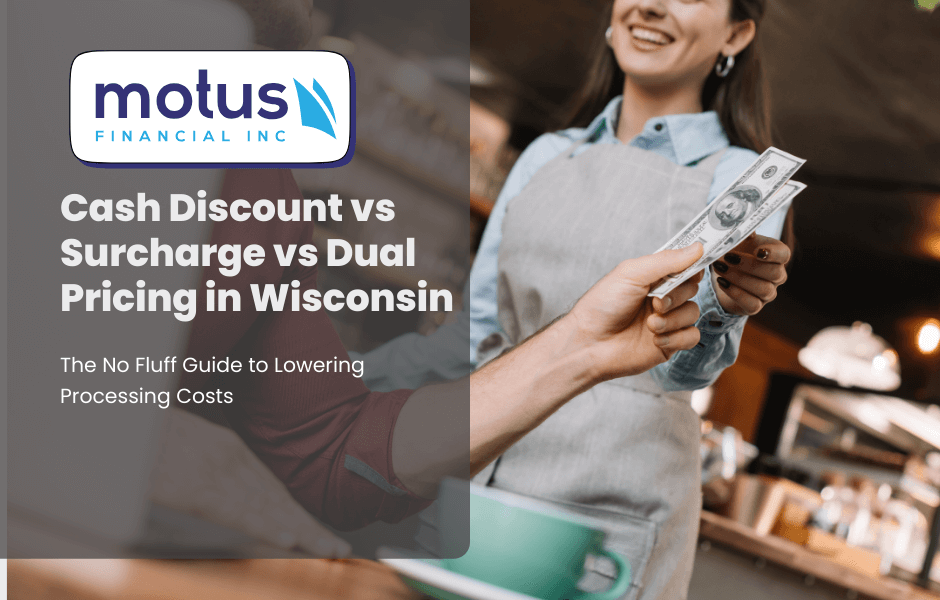
Cash discount: you list a price, and customers who pay with cash receive a discount off that listed price.
Surcharge: you list a price, and customers who pay with a credit card pay an added fee disclosed at the point of sale.
Dual pricing: you display two prices up front, one for cash and one for card, and the customer chooses.
Same goal, three different stories. The story matters.
The real decision is customer psychology, not math
Business owners often ask which program saves the most. That matters, but it is not the first question.
First question: what will my customers accept without friction?
A busy counter service spot in Madison has a different customer vibe than a salon in Middleton. A contractor billing commercial clients has a different flow than a boutique in Sun Prairie. If you pick the max savings model but it causes confusion at checkout, you will lose time and goodwill.
Cash discount: Usually the softest story
Cash discount often feels customer friendly because it sounds like a reward, not a penalty.
Where it breaks is execution. If signage is unclear or staff hesitate, the checkout moment turns into a conversation. Conversations during a rush are where good programs go to die.
Surcharge: Direct, but needs clean execution
A surcharge is more literal. It adds a fee to credit card transactions and discloses it.
The risk is tone. If staff apologize for it, it sounds like punishment. If staff explain it neutrally and point to clear signage, it becomes a normal policy, like sales tax.
Dual pricing: The transparency play
Dual pricing puts both numbers in front of the customer from the start.
This can prevent the checkout surprise entirely, because the customer already saw both prices and made a choice. It is a strong fit for restaurants and cafes that can display pricing clearly.
The catch is clean implementation. Your POS has to calculate correctly. Prices have to display correctly. Staff have to answer questions consistently.
Putting them in context
Cash discount is usually the softest framing and works best when cash is still common and checkout is fast.
Dual pricing is the most transparent and reduces checkout surprise, but it demands clean menu and POS execution.
Surcharge is the most direct and can work well in professional or higher ticket settings where customers expect card costs to show up somewhere.
None is universally better. The best one is the one your customers accept without debate and your staff can explain in one calm sentence.
The compliance and signage piece: Make it obvious
No matter which model you choose, execution is everything.
You need clear signage at entrances and point of sale, receipt language that matches the program, pricing displays aligned with how you charge, and staff training so explanations sound the same.
For cash discount questions, this contact page is the fastest route: Cash discount contact form
The pricing model underneath still matters
Fee recovery programs are not a magic wand if your underlying processing setup is messy.
A good provider should be able to review your statement and explain, in plain English, what you pay today and what a cleaner structure would change.
For the Madison context on processing structure and questions to ask, see: Credit card processing in Madison, WI
The scripts that work
The best scripts are short and boring. Boring is good, because boring means it is not a big deal.
- Cash discount: We offer a cash discount. Card payments include the processing cost.
- Dual pricing: We show two prices, cash price and card price.
- Surcharge: Card payments include a small processing fee. Cash does not.
The mistake is making it sound like a confession. This is not a confession. It is a policy.
FAQs
Is a cash discount program legal in Wisconsin?
Cash discount programs are commonly used, but execution matters. Clear signage and a compliant setup are the important pieces.
What is the difference between surcharge and cash discount?
Surcharge adds a fee to card payments. Cash discount provides a discount to cash payments. The math can be similar, but the customer experience feels different.
Will customers get upset about these programs?
Some customers will complain about anything. Most customers accept clear policies when disclosed up front and explained simply.
Do I need special POS settings for dual pricing?
Often yes. The cleanest experience is when your POS supports it so receipts and totals are accurate without manual adjustments.
How do I know which program saves me the most?
A statement review plus your transaction patterns shows realistic outcomes. Math alone is not enough.
Next step
If you want to pick the right program and roll it out without customer friction, start here: Contact Motus Financial





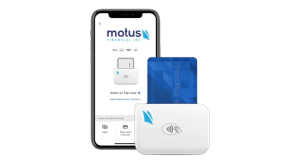
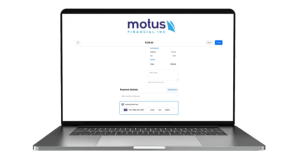
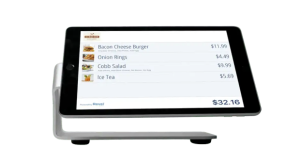 Our POS systems are designed to streamline in-store transactions. With features like inventory management, sales reporting, and customer tracking, our POS solutions help you run your business more efficiently. Our terminals are compatible with various payment methods, including chip cards, contactless payments, and mobile wallets.